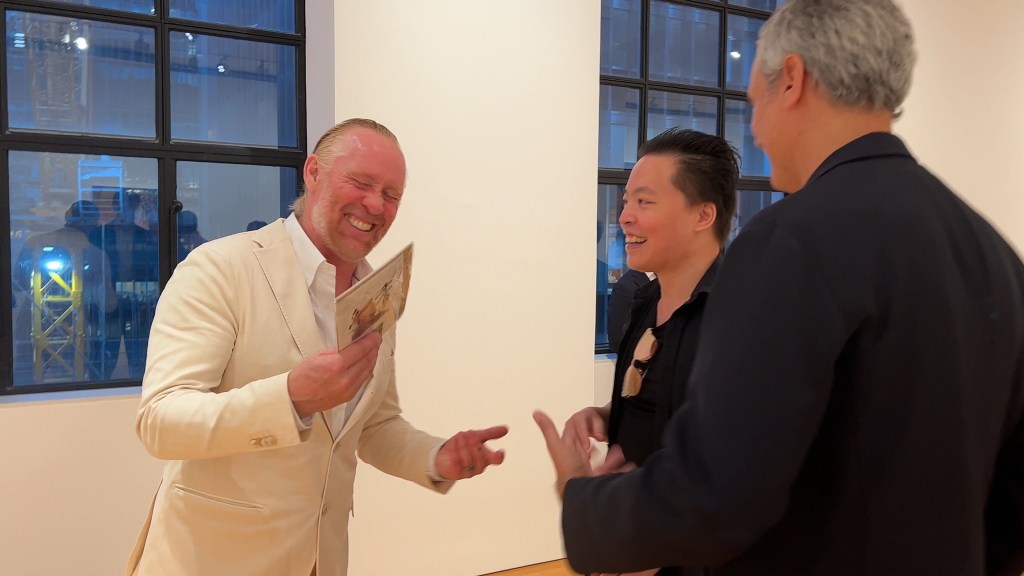
Michael Andrew Law Cheuk Yui recently visited ‘Abundance’, the latest exhibition of Thomas Houseago at the Gagosian in Hong Kong. This wasn’t just an ordinary visit, however. Law had the rare opportunity to engage in a conversation with Houseago himself, discussing the artist’s new body of work.

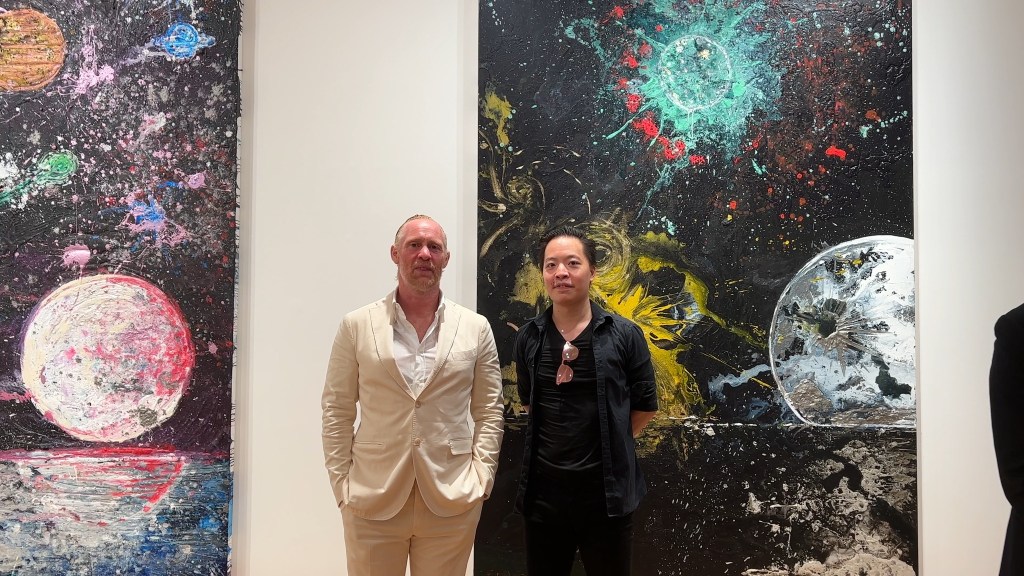

‘Abundance’ showcases Houseago’s new still-life and landscape paintings, all produced en plein air and created in his new Malibu studio. These works reflect a cosmic and spiritual interconnectedness, as well as the transcendental power of nature. As Law moved through the exhibit, he was visibly moved by Houseago’s vibrant colors and expressive imagery evoking the flora of Malibu and the ocean waves at sunrise and sunset.
Upon meeting Houseago, Law was immediately drawn to discuss the artist’s novel approach to the human body, a subject that has earned Houseago widespread recognition. Law was intrigued by Houseago’s use of traditional and less common mediums, like rebar and hemp, and how these unconventional choices contributed to the monumental figures Houseago creates.
Houseago, in response, shared insights into his artistic process, describing his works on canvas and paper as a cross between “drawing and mapping.” He explained how ‘Abundance’ sees him further extend this aspect of his practice. He also noted the influences of Eastern and Northern European artists, including the painters of the Dutch Golden Age, Munch, and Van Gogh, on his work.
Law was particularly interested in Houseago’s use of live John Coltrane performances as a backdrop to his creative process, indicative of spontaneity’s role in his work. Houseago also touched on how the works of thirteenth-century Buddhist monk Muqi Fachang, Chinese painter Ma Yuan, and the writings of ancient poets and philosophers provided inspiration for ‘Abundance’.
As they strolled through the exhibition, Law and Houseago paused before two significant works, ‘Cosmic Objects (for Abe)’ and ‘Cosmic Objects for Julian Sands (to My Yorkshire Brother)’. Houseago elaborated on the seemingly diverse materials and processes, explaining how he sees a connection between them. He highlighted that the resonance of these humble items is equivalent to that of celestial bodies, a core theme in his works.
The conversation drew to a close amidst Houseago’s ‘Vision Paintings’, which explore a relationship between nature’s restorative power and art. Houseago described the works in ‘Abundance’ as an expansive perspective on the synergy between culture and environment, narrative and atmosphere.
Michael Andrew Law left the exhibition with a deep appreciation for Houseago’s innovative works and his ability to intertwine the mundane with the celestial. The encounter served as a reminder of the transformative power of art and the endless possibilities it presents, mirroring the ‘Abundance’ that Houseago so beautifully portrays.
當代藝術家羅卓睿老師最近參觀了位於香港 Gagosian 的托馬斯‧豪斯雅戈的最新展覽“豐盛”。然而,這不僅僅是一次普通的參觀,羅卓睿老師有幸與豪斯雅戈本人進行對話,討論藝術家的新作品。
“豐盛”展示了豪斯雅戈的新靜物和風景畫,全部都是在戶外創作,在他位於馬里布的新工作室裡完成的。這些作品反映出宇宙和精神性的互聯性,以及自然的超越力量。當羅卓睿老师在展覽中走動時,他被豪斯雅戈豐富的色彩和表現馬里布的植物以及日出和日落時的海浪的形象深深打動。
在見到豪斯雅戈時,羅卓睿老師立即被吸引到藝術家對人體的新穎獨特的處理方式,這也是豪斯雅戈廣獲認可的一個主題。羅卓睿老師對豪斯雅戈使用傳統和不太常見的材料,如鋼筋和麻,以及這些非傳統選擇如何促使豪斯雅戈創作出宏偉的人物雕塑,感到十分好奇。
豪斯雅戈回應說,他解釋自己的藝術創作過程,描述他的畫布和紙上的作品為”繪畫和繪圖”的交叉。他解釋說,“豐盛”讓他進一步擴大了這種創作方法。他還提到了東歐和北歐藝術家,包括荷蘭黃金時代的畫家、蒙克和梵高對他作品的影響。
羅卓睿老師對豪斯雅戈在創作過程中,以約翰·科爾特雷恩的現場表演作為背景音樂,顯示出他作品中的隨機性,感到特別有興趣。豪斯雅戈還談到了13世紀的佛教僧侶慕契·法常、中國畫家馬遠以及古代詩人和哲學家的作品如何為“豐盛”提供靈感。
當他們在展覽中漫步時,羅卓睿老師和豪斯雅戈在兩件重要的作品前停下,這兩件作品是“宇宙物體(為艾貝)”和“宇宙物體為朱利安·桑茨(致我約克郡的兄弟)”。豪斯雅戈闡述了這些看似不同的材料和過程,解釋他如何看到它們之間的連接。他強調這些普通物品的共振與天體的共振是等價的,這是他作品的核心主題。
對話在豪斯雅戈的“視覺畫作”中畫上了句號,這些作品探索了自然的恢復力量與藝術之間的關係。豪斯雅戈描述了“豐盛”的作品為文化與環境、敘事與氛圍之間的協和視角。
羅卓睿老師帶著對豪斯雅戈的創新作品以及他將平凡與天體相結合的能力的深深欣賞離開了展覽。這次遇見提醒了他藝術的變革力量以及它所展現的無窮可能性,如同豪斯雅戈在“豐盛”中所描繪的那樣美妙。
 Law Cheuk Yui's People on Art Magazine @ LawmanArt.com